.webp)
Dear friend,
I am glad you are here. I mean that. If you clicked into this letter, it is probably because some part of your life at home has started to feel heavier than you say out loud.
Maybe it is your mom. Maybe your dad. Maybe your husband or wife. Maybe someone you care for who lives down the hall or across the country. Whoever it is, you have likely had a version of this moment: you are stirring coffee, or answering an email, or trying to get a kid out the door, and you hear that gentle voice again.
“What day is it today?”
And you answer. Sweetly, at first. Then later, still sweetly, but with a little less air in your lungs. Then later still, you answer through your teeth because you are human and repetition wears a groove in your patience even when your heart is full of love.
If that is you, please hear me clearly: you are not a bad person for feeling tired of repeating the date. You are a person under load. And the person you love is not “trying to annoy you.” They are often trying to feel steady in a world that suddenly asks them to work harder than before just to know where they sit inside a week.
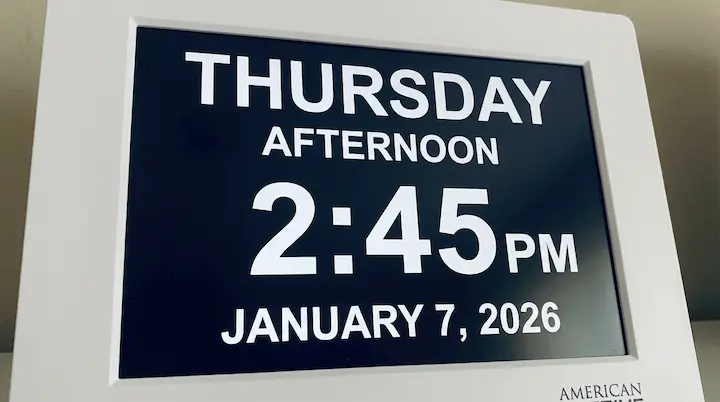
This letter is about one product. I will name it plainly so you never feel like I am hiding the point: the American Lifetime Digital Calendar Day Clock with alarm, sold on the company’s own site, with a two-year warranty listed right on the page. It is a clock, yes, but more than that, it is a sentence on the wall that never gets impatient. It tells the full day of the week, the full date written out without abbreviations, and the part of the day in big words: Morning, Afternoon, Evening, Night. Letters large enough to read from a chair. Always there. Always the same gentle voice.
I am going to walk you through why that matters emotionally, practically, financially in terms of your own energy, and day-by-day in a real house. I am going to repeat the important ideas more than once on purpose, because when we are worried about someone we love, sometimes we need to read the same reassurance in a few different shapes before it lands.
Take your time. Pour another cup if you want. This is long on purpose.
If you love someone who sometimes loses track of time, you already know this is not a small thing. It is not “just a quirk.” It is a thread that pulls through the whole day.
It shows up at breakfast when the light through the curtain does not match what their body expects. It shows up at mid-morning when the house is quiet and the TV is off. It shows up when the mail comes and they want to know if “that letter was supposed to arrive today or next week.” It shows up at dusk when shadows stretch and the room suddenly feels like it skipped a chapter.
It is the question at the kitchen table. Again in the hallway. Again after dinner when you thought everyone was finally relaxed.
It is the way they look at the window as if the sky owes them a label. It is the way you feel your chest tighten because you cannot be in two rooms at once, and you cannot be the only clock in the house forever without paying a price in your own sleep and your own temper.
You are not failing them. You are carrying something heavy with two hands while the world keeps handing you more grocery bags.
What they need is not another sharp sticky note. What they need is something steady that does not get tired. Something that says, in plain English, in letters big enough to read from across the room:
TODAY IS WEDNESDAY. HERE IS THE FULL DATE, WRITTEN OUT. HERE IS WHAT PART OF THE DAY YOU ARE IN: MORNING, AFTERNOON, EVENING, OR NIGHT.
That is what this American Lifetime clock is built to put in front of them, hour after hour, without sighing, without rushing, without making them feel small.
After we brought it home, I finally felt like I could breathe again in my own kitchen. Not because every problem vanished, life is bigger than any clock, but because the constant low hum of calendar anxiety dropped in our house. That alone was worth every penny.
→ See specs and order on the official American Lifetime site
PART ONE: THE PROBLEM ALMOST NO ONE POSTS ONLINE (BUT SO MANY LIVE WITH)
We do not talk about this enough. Not really.
Social media shows the shiny parts of family life. It does not show the Tuesday your parent asked, softly, if it was still the same week. It does not show the shame that flooded you when you snapped, “I just told you!” and then saw their face fall. It does not show you lying awake replaying that moment, hating yourself, knowing you did not mean it the way it sounded.
That shame is a lie your stress tells you. You are overloaded. You are juggling work, children, bills, your own health, appointments, and the quiet grief of watching someone you adore feel unsure inside the same walls where they used to feel like the captain of the house.
When someone feels unsure about the date or the time of day, it is easy for outsiders to misunderstand. It can look like “not paying attention.” It can look like “being difficult.” In truth, it is often anxiety looking for an anchor. When the day feels slippery, a clear answer is not “extra.” It is relief.
Clarity is kindness. I want you to write that on your heart if you need permission: putting information where it is easy to see is not insulting. It is respectful. It says, I want your day to feel solid under your feet.
Here is what makes the problem harder in modern homes: most of the tools we use are bad anchors for people who want simplicity and size.
- Smartphones pack tiny type, endless icons, notifications, and steps that change with every update. They are powerful for you and me. For someone who only wants to know “what day it is” without unlocking a maze, they are often the wrong tool.
- Traditional wall clocks show hands, sometimes numbers, but usually not the name of the day, not the month spelled out, and not whether we are in the morning or evening chapter of the day.
- Televisions only help when they are on. The rest of the time, they are a black rectangle. Any tiny clock in the corner is easy to miss.
- Paper calendars help until the print is small, the room is dim, the page is not turned, or handwriting becomes hard to read at a distance.
- Sticky notes curl. Whiteboards smudge. Voices get tired.
So who becomes the anchor when the tools fail?
You. Again and again. You become the living calendar. You become the living reassurance. And even when you want to be gentle forever, your voice is attached to a human nervous system that gets worn down.
That is not a moral failure. That is physics. That is emotional bandwidth. And it is exactly why a dedicated display, one job, always on, always large, can change the emotional weather of a home.

PART TWO: WHAT IT FEELS LIKE ON BOTH SIDES OF THE TABLE (AND WHY THAT MATTERS FOR SALES, TOO)
I want to slow down here, because if you are going to spend money on anything for your family, you deserve to know exactly what pain you are buying relief from.
On their side of the table, repeated questions are usually not fun for them either. Many people feel a flash of embarrassment after they ask. Some laugh it off. Some go quiet. Some get a little sharp, not because they are angry at you, but because shame and fear can wear the mask of irritation.
Some people start looking for clues everywhere: the mail, the news anchor, the neighbor’s car, the angle of the sun. They are trying to build a story that holds still. When the story wobbles, the whole room feels unstable.
Some stop inviting friends over because they do not want to feel “off” in front of company. Some stop going to daytime activities because they are afraid they will miss a ride or show up on the wrong day. Some stay in their chair longer than they should because getting up feels like stepping into fog.
On your side of the table, you start to brace yourself. You hear footsteps in the hall and your shoulders rise a quarter inch before you know it. You love them. You would do anything for them. You are also running on limited sleep, limited patience, and a to-do list that does not care how noble your heart is.
You begin to measure your tone. You hate that you have to measure your tone in your own house.
Neither of you is the villain. The villain is uncertainty. The villain is a house that does not answer simple questions in a simple way.
What broke my heart with my dad was not one movie-scene moment. It was the accumulation. The tight smile. The pause before he asked again. The way he stopped suggesting we call old friends because he did not want to risk feeling confused mid-conversation. The way he watched me across the table like my face was the only proof of what day it was.
I wanted him to feel capable in his own space. Not monitored. Not babied. Supported. I wanted him to look at something besides my face and still feel the day snap into place.
So I went looking for a tool that could sit in the living room like a piece of household peace: always on, always clear, always respectful. Not a lecture. Not a gadget that needs a teenager to fix it every week. A steady sentence on the shelf.
That search is how I found the American Lifetime digital calendar day clock. And once you understand the emotional side, what I just laid out, the technical side suddenly makes sense. Of course you want full words. Of course you want large letters. Of course you want Morning, Afternoon, Evening, Night spelled out. Of course you want alarms that can hold hands with routine. Those are not “features for features’ sake.” They are the shape of compassion in hardware form.
→ View the American Lifetime clock on the official product page

PART THREE: THE TURNING POINT, WHY THIS CLOCK (AND NOT THE OTHER NINE YOU ALMOST BOUGHT)
I have bought well-meaning gadgets before. Some gathered dust because they were fiddly. Some felt subtly insulting because they looked like hospital equipment in the living room. Some were so complicated that I became full-time tech support, which defeated the whole point: I was trying to buy less mental load, not more.
When I landed on the American Lifetime digital calendar day clock, I read the listing slowly. I compared it mentally to everything we had already tried: the wall calendar with tiny boxes, the whiteboard that dried out, the phone I did not want my dad to depend on, the regular clock that never told him whether it was Tuesday or Wednesday.
Three things jumped out immediately, and I will explain each one in plain language because this is the core of why I am willing to write such a long letter:
- Non-abbreviated wording. The full day of the week and a complete date written out the way people actually say it. Not “Tue” hiding in small type. Not a string of numbers you have to decode. When someone is already working harder to feel oriented, abbreviations are one more hoop. This clock removes the hoop.
- Time-of-day clarity in big words: Morning, Afternoon, Evening, Night (or the equivalent labels the unit uses). That matters more than outsiders think, because light lies sometimes, especially in winter, especially near windows with heavy curtains, especially when naps blur noon and four. A wall clock tells you where the hands sit. This tells you what chapter of the day you are in.
- Large, high-contrast display. Built to be read at a glance from a favorite chair several feet away. If you have watched someone hunt for reading glasses just to check a screen, you know why size is not vanity. Size is access.
On top of that, the product includes alarm functions you can use for real life. I am going to say this carefully because I respect your intelligence: alarms are not a replacement for a nurse, a doctor, or common sense. They are a gentle rhythm partner. Think breakfast structure, hydration nudges, a cue that a home health aide is due, a reminder to switch the laundry, a soft prompt before bedtime routines. You decide what your house needs. The clock holds the beat so your voice does not have to carry the whole song alone.
The official listing also highlights something that mattered to my practical side: a 2-year warranty. I am tired of electronics that die in ninety days and vanish into a landfill of regret. If I place something in my father’s line of sight every single day, I want it backed like a serious purchase, not a novelty.
Let me say the same idea a second way, because repetition is how worried minds absorb hope: this is a single-purpose clarity machine. It is not trying to be your email. It is not trying to be social media. It is trying to answer the questions that quietly drain a household: What day is it? What is the full date? Is it morning, afternoon, evening, or night? And it tries to answer those questions in letters your eyes can grab without a fight.
→ Check pricing, bundles if available, and shipping on the official American Lifetime page
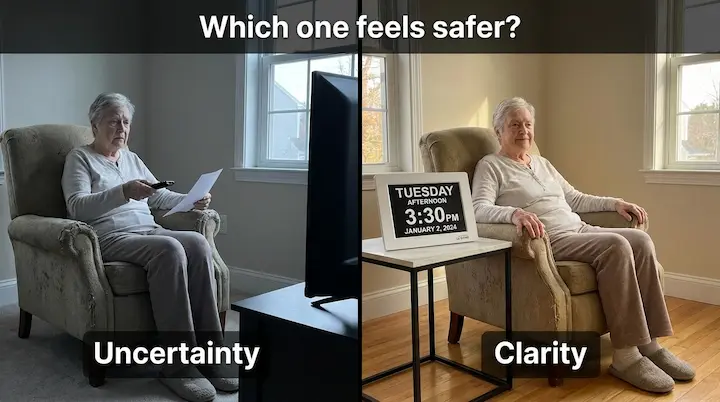
PART FOUR: WHAT “INDEPENDENCE” REALLY LOOKS LIKE, ROOM BY ROOM, HOUR BY HOUR
Independence is not always a fireworks moment. Sometimes it is painfully ordinary, and that ordinariness is the whole victory.
It is your mom pouring her own coffee without saying your name first like a prayer. It is your uncle laughing at a game show because he is not stuck in a loop trying to rebuild the day from scratch. It is your spouse walking past the hall table, glancing up, nodding once, okay, I know where I am, and moving on without needing a human echo.
A well-designed day clock supports rhythm, not drama. Rhythm is what makes a house feel safe. Rhythm is what lets love sound like love again instead of like administration.
Below is a long list of real-life situations families describe. I am not promising your house will mirror every line. I am showing you how wide the usefulness is, because when you are worried about someone you love, you deserve to see the full picture of how a tool might actually earn its space on the shelf.
- Morning grounding: The first hour after waking can feel fuzzy for anyone. For someone who already feels unsure, it can feel like stepping onto ice. A display that says the weekday, the full date, and “Morning” in large type is a handrail.
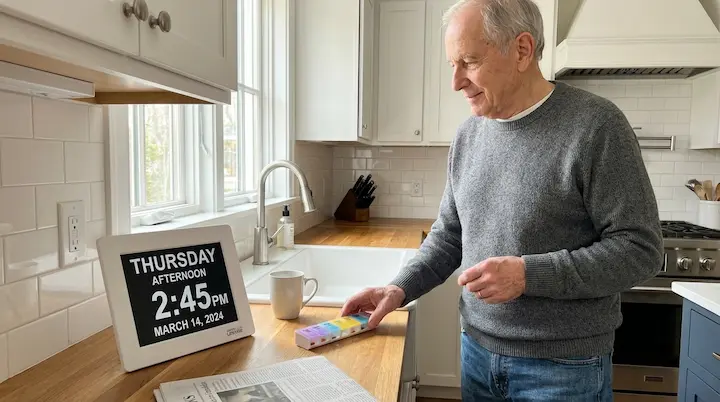
- Breakfast and kitchen rhythm: The kitchen is the nerve center. If the clock sits where coffee is made, orientation becomes part of the ordinary path of the day instead of a special event.
- Meal structure when days blur: Bodies still want lunch and dinner even when the calendar feels mushy. Pairing meals with a visible anchor reduces the “did I already eat?” swirl for some households.
- Hydration nudges: An alarm can be a simple glass-of-water cue. Small? Yes. Cumulative for health and comfort? Also yes.
- Medication timing support: If your family uses scheduled medicines, a clock alarm can be a secondary cue, never a substitute for medical advice, labels, or common sense, but a steady partner in routine.
- Before appointments: “Your ride comes at two” is easier to hold in the body when the day is labeled clearly all morning.
- When visitors arrive: Some people feel shy about “being wrong” about the day in front of guests. A clear display reduces that social edge.
- Afternoon slump honesty: When the light is flat and the house is quiet, “Afternoon” spelled large can prevent that hollow feeling of time slipping away unnoticed.
- Evening and dusk: Short winter days are brutal. Sunset at four-thirty can feel like the world ended early. Seeing “Evening” can reframe the story: you did not miss the whole day; you are simply in the evening chapter.
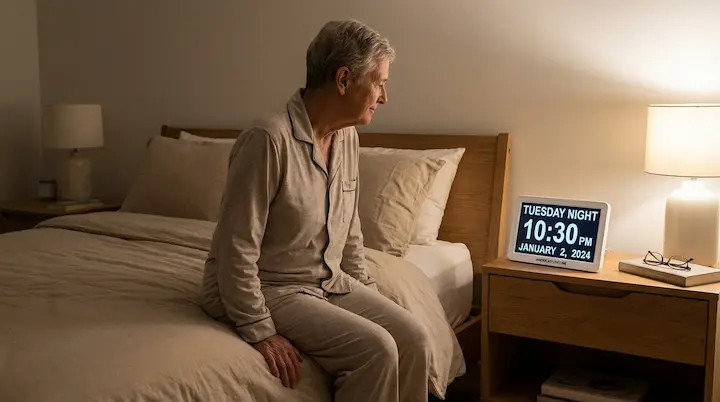
- Night routines: A gentle alarm can mark TV off, teeth brushed, lights lowered, whatever your family’s wind-down looks like.
- Long-distance adult children: You cannot be there every hour. A dedicated clock is a tangible way to say, I am still helping hold the structure of your day.
- Partners who resist “being helped”: Framing the clock as a living-room upgrade for everyone often lands softer than framing it as “for you because you need help.”
If even two or three of those scenarios sound like your house, you are not overreacting. You are noticing friction early, and early support is one of the kindest things families can give each other.
→ See if this clock fits your situation, official American Lifetime listing
PART FOUR-B: LET ME AGITATE THE PAIN A LITTLE (BECAUSE SWEET LIES DO NOT HELP YOU DECIDE)
I am not here to scare you for sport. I am here to tell the truth you already half-know.
If the questions about the day keep coming, and the only answer is your voice, your relationship will strain even when love is huge. Not because anyone is bad. Because humans have limits.
You will start answering shorter. You will start answering sharper. You will start feeling guilty before they even open their mouth. They will start reading your face and feeling like a burden even when you never called them that.
None of that is theoretical. That is what silent repetition does to a kitchen over months.
The American Lifetime clock does not replace your love. It replaces the part of your love that has been forced into a job it was never meant to do alone: being the entire timekeeping system for another adult.
When that weight shifts onto a steady screen, you get pieces of yourself back. Patience returns. Jokes return. You stop flinching at footsteps.
That is worth repeating: you deserve to stop flinching in your own home.
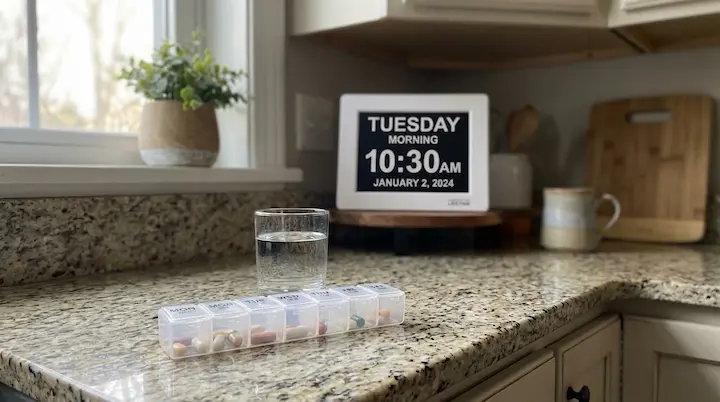
PART FIVE: BENEFITS VS. FEATURES, LINE BY LINE, THEN AGAIN IN PLAIN ENGLISH
Features are facts on a spec sheet. Benefits are what those facts do to your nervous system when you live with them every day. You deserve both, slowly, twice.
Feature: Large digital letters.
Benefit: Less squinting. Less hunting for glasses. Less frustration that shows up as tension in the jaw. More confidence at a glance. More dignity in the simple act of checking the time.
Feature: Full date without abbreviations.
Benefit: No decoding “Wed” versus “Thu” on a screen the size of a credit card. The week reads the way people say it out loud at the dinner table. That sounds small until you watch someone relax because the words finally look like the truth they were trying to hold.
Feature: Clear period of day: Morning, Afternoon, Evening, Night.
Benefit: The sun through the curtains stops being the only storyteller. The clock names the chapter. That reduces the hollow spin of “I must have lost the whole afternoon” when really you are simply in the afternoon.
Feature: Alarms.
Benefit: Structure that can feel like a gentle hand on the shoulder instead of a person raising their voice down the hall. Especially when you are at work, in the shower, or asleep, and you cannot be the cue.
Feature: Straightforward home setup (as described on the official listing).
Benefit: You are not signing up to become unpaid tech support for the next year. The point is peace, not a new hobby fixing menus.
Feature: 2-year warranty (stated on the official product page).
Benefit: You are not gambling on a no-name clone that dies after a season. You are buying with backup.
Now here is the same translation I gave my sister when she asked, “Is it worth it?”: less repeating yourself, less tension in your voice, more normal conversations about TV, grandkids, weather, recipes, the stuff that makes a house feel like home again.
And again, because you might need to read it when you are tired: this clock is not magic. It is a steady witness. It holds the date when your hands are full. It holds the part of the day when the light lies. It holds alarms when you cannot be the alarm. That is the whole pitch. Everything else I say in this letter is just evidence for that simple truth.
→ Order or compare options on the official site
PART SIX: OBJECTIONS, THE WHISPERS IN YOUR HEAD, ANSWERED AT LENGTH
Your mind is probably throwing up objections while you read. Good. That means you are serious. Let me talk to each objection the way I would talk to my own cousin if she were sitting on my porch worrying.
Objection: “We already have clocks.”
Most clocks tell time in one narrow way. They rarely tell the whole story of the day: full weekday, full written-out date, and a plain-language label for morning, afternoon, evening, or night. If your current setup already does all of that in huge letters your loved one reads without stress, wonderful, you may not need this. If not, you are not duplicating a clock. You are filling a gap your wall clock was never built to close.
Objection: “They will never use technology.”
This is not a smartphone with a lock screen and fifty apps. It is a dedicated display with a focused job: stay readable, stay constant. Many people who want nothing to do with a mobile phone will still glance at a large clock on a table they pass forty times a day.
Objection: “It might feel insulting.”
Framing matters. I did not hand my dad a lecture. I did not say, “You need this because you keep asking.” I said, “We upgraded the living room clock so everyone can see the date from the couch.” That is the truth. It is also kinder to his pride. Large print is not shame. Large print is accessibility. We accept that for books. We can accept it for time.
Objection: “What if the alarms annoy them?”
Start with one or two. Choose gentle times. Choose purposes that feel helpful, tea, lunch, a favorite show, not a parade of nagging. Adjust volume if the device allows. Think of alarms as training wheels on routine: you can loosen them as the house settles.
Objection: “I will wait until things get worse.”
That is the trap compassionate people fall into. We wait until the strain is screaming. Early support often preserves confidence and calm longer. Making the environment clearer is not “jumping the gun.” It is building a wider sidewalk so nobody trips on the edge.
Objection: “I cannot afford another mistake.”
Fair. That is why I care about the two-year warranty on the official listing and why I keep nagging you (yes, me nagging you) to buy from the real American Lifetime product page, not a random resale listing with no support. Mistakes are expensive. Buying from the source is how you buy accountability.
Objection: “My sibling will roll their eyes.”
Maybe. Families are messy. But a clock on a table is easier to tolerate than a group text war. Sometimes a concrete object shifts the conversation from opinions to facts: here is the date, here is the day, here is the part of the day.
Objection: “What if it does not work for us?”
Then you read the return policy on the official site like any adult purchase. But I will tell you honestly: in our house, the emotional shift showed up before any “feature appreciation.” The room felt different first. That is hard to capture on a spec sheet.
→ Read full details and order from the official American Lifetime store
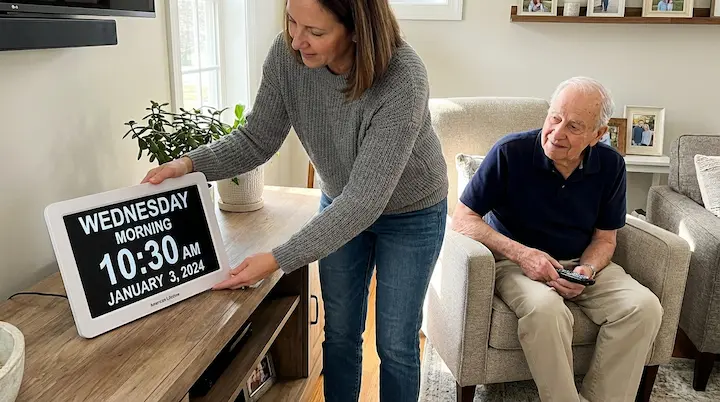
PART SEVEN: THE DAY WE PLUGGED IT IN, WHAT CHANGED FIRST, SECOND, AND THIRD
I will not insult you by pretending a clock fixed every worry in our family. Health is bigger than gadgets. Grief is bigger than gadgets. Marriage stress and money stress are bigger than gadgets.
But I will tell you, with clean honesty, what shifted first, what shifted second, and what shifted third, because those three waves are what sold me that this purchase was not superficial.
First: the loop broke. Dad stopped opening every conversation with the calendar like a door he could not get through. He still asked sometimes, because people do, but the urgency drained out of it. He would glance at the screen, read the weekday and date out loud almost without thinking, and then move on to the next topic, the weather, the ball game, whether we needed milk.
That sound, his own voice, calm, reading the date, meant more to me than a hundred reassurances from my mouth. It meant his eyes found proof without needing my face to be the proof.
Second: the room got quieter in the way rooms get quieter when tension drops. My sister noticed on a video call. She said, “He seems lighter.” She was right. It was not magic. It was relief.
Third: I got pieces of myself back. I made dinner without bracing mid-chop for the same question looping behind me. I answered work emails without flinching at every footstep in the hall. I slept a little deeper, not because I am dramatic, but because peace in a house is built from tiny repetitions, and we had been repeating stress until it felt normal.
When stress feels normal, you stop noticing how expensive it is until it eases.
If you are waiting for a sign that you are allowed to try something practical: this is it. You are allowed. You are not dramatic. You are not overreacting. You are a person who sees friction and is considering removing it with a tool built for exactly that job.
→ Get the American Lifetime Digital Calendar Day Clock from the official page

LETTERS FROM READERS (THE KIND OF STORIES YOU ONLY HEAR IN PRIVATE)
I cannot introduce you to every person who has ever bought this clock. What I can do is share the kinds of messages people send when they feel less alone, the themes, the sentences that repeat, the relief that sounds the same even when the details differ.
Reader theme one: “I stopped being the bad guy.” Over and over, people say some version of this: they were not angry at their parent. They were tired. The clock removed the friction so their tone could go back to sounding like love.
Reader theme two: “The full words mattered more than I expected.” Abbreviations look fine until you watch someone lean in, squint, and still not feel sure. Full weekday names and full dates sound like speech. Speech feels like reality.
Reader theme three: “Winter got easier.” When the sun drops early, the “Evening” label helps people trust they have not “lost” a whole day to darkness.
Reader theme four: “The warranty closed the sale.” Many families have been burned by cheap electronics. A two-year warranty on the official listing reads like respect for your money.
Scroll down for more comment-style notes at the bottom of this page as well, same idea, different voices.
→ Join families who chose the official American Lifetime clock
PART EIGHT: URGENCY, HONEST, NOT MANIPULATIVE
I am not going to scream fake countdown timers at you. I hate that garbage. It treats you like you are foolish, and you are not.
But I will say what is true in the real world:
Demand for home clarity tools has grown. More families are naming the quiet strain they used to swallow. More people are realizing that environmental support is not “giving up”, it is building a gentler house.
Popular items can sell through at busy times. Shipping can slow around holidays. If you have been telling yourself you will “look into it later,” later often means another month of the same conversational loop, another month of bracing when you hear footsteps, another month of guilt when your voice comes out shorter than you meant.
You do not need permission to make home gentler. You need a decision, and a link to the official page where you can read the details with your own eyes.
And let me repeat the core promise one more time, because sales letters earn their length by circling back to the center: the American Lifetime Digital Calendar Day Clock is built to show the full day of the week, the full date without abbreviations, and the part of the day in large, clear language, with alarms you can shape around your routines, backed by a two-year warranty on the official listing. That is the whole reason I wrote you this many words.
PART EIGHT-B: FOR THE LONG-DISTANCE SON OR DAUGHTER, AND FOR THE SIBLING WHO CARRIES THE LOAD AT HOME
Maybe you live two states away. Maybe you video call every night and still feel a thousand miles from what is really happening in the hallway when nobody is performing “fine” for the camera.
You ask, “How was today?” and everyone says “Fine.” Families protect each other that way. Then worry spills over anyway in the form of short texts, tense voices, or silence that says more than words.
Here is what helped my sister and me stop triangulating guilt across time zones: we stopped trying to be the clock. We bought the clock.
She is local. I am not. Before, our messages ping-ponged like this:
“Did Dad take his morning pills?”
“I think so?”
“Is he sure what day the appointment is?”
“I wrote it on the pad…”
“Is he sure he saw it?”
That is not because we are controlling people. It is because love tries to fill gaps. When the environment does not hold the date steady, love tries to hold it with texts. Texts are exhausting. Texts can sound sharp even when nobody means harm.
After we set up the day clock with a few well-chosen alarms and a visible place in the living room where the weekday and full date were always present, the texts changed tone. More jokes. More grandkid photos. Less emergency-flavored micro-management.
That is not trivial. That is family culture healing a little.
If you are the sibling who does most of the in-person support, you may resent anything that sounds like an “easy fix” from someone who is not there. I understand. This is not a fix for everything. It is a pressure valve for a specific stressor: time and date uncertainty. That stressor drains patience faster than almost anything else because it never stops asking.
If you are the long-distance sibling, buying the clock can be a concrete act of love that does not sound like empty “Let me know if you need anything.” It sounds like: “I see the load. I am putting something steady in the room.” It is a gift that keeps answering the date when you cannot be there to answer it yourself.
Repeat for the long-distance readers, because guilt loves to lie: buying support tools is not abdication. It is participation. It is a way to be present when you cannot be present.
→ Ship it to their house or yours, start on the official American Lifetime page
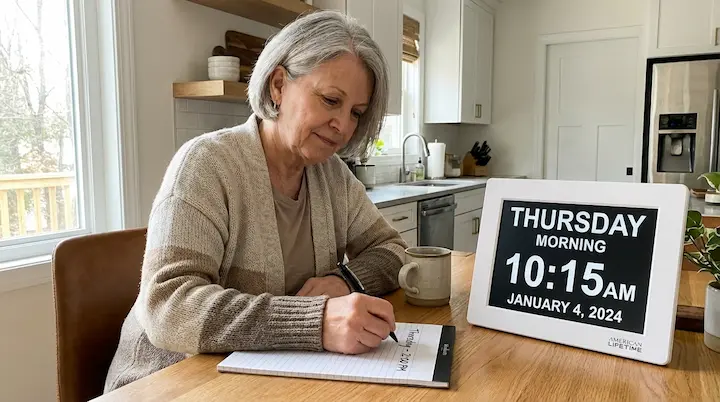
DEEP DIVE: WHY “MORNING / AFTERNOON / EVENING / NIGHT” MATTERS MORE THAN MOST PRODUCT DESCRIPTIONS EXPLAIN
Humans stitch the day together using light, meals, routines, social cues, and habit. When any of those threads loosen, the story of the day can feel fuzzy, not always in a dramatic way, but in the quiet way that makes someone ask again what time it “really” is, or whether the afternoon “got away” from them.
A classic wall clock answers a narrow question: where the hands sit right now. That is useful. It is also incomplete for many people who are not struggling with “hours and minutes” as much as they are struggling with placement inside the day.
A strong day clock answers a wider question: where am I inside the day? That is a different kind of information. It is emotional orientation layered on top of numerical time.
When the display says “Morning,” it whispers a whole story: start routines, daylight expectations, the pace of breakfast, the sense that the world is opening. When it says “Afternoon,” it anchors the middle, the errands, the visit hours, the quiet slump some people feel after lunch. When it says “Evening,” it signals wind-down, dinner logic, softer lighting. When it says “Night,” it supports the idea that rest is appropriate, not failure.
That is why the period-of-day wording hits different. It is not fluff marketing. It is a sentence that answers the fear beneath many repeated questions: Am I on schedule? Did I lose time? Is it too late? Is it too early?
In winter, when sunset arrives like a rude guest at four-thirty, that label can interrupt a spiral of “I must have lost the whole day.” It replaces catastrophe thinking with a simpler truth: it is evening, and evening is allowed to be dark.
In summer, when light stretches late, it can anchor bedtime kindness without argument: the sky may look like five, but the chapter is evening, and evening routines can still begin.
You are not making a big deal out of nothing. You are aligning the room with how humans actually experience time when they are home, tired, aging, or anxious. That is not excessive. That is thoughtful.
Say it again, because this is the heart of the product: full weekday, full written date, large letters, and a named part of the day. That combination is what separates this category of clock from the one you already have hanging near the kitchen door.
FAQ-STYLE QUESTIONS (THE ONES YOU ARE TOO TIRED TO GOOGLE AT MIDNIGHT)
Will they actually look at it?
In most homes I have heard from, yes, when placement is treated seriously. Put it where life already happens: near the television, on the side table by the chair, on the kitchen counter by the kettle, on the dresser in the line of sight from the bed. You are not asking someone to build a brand-new habit from zero. You are inserting clarity into paths they already walk.
What if they ignore it at first?
Sometimes people ignore new objects until the object stops feeling new. Give it time. Point to it once with calm curiosity, not pressure. Let the display keep speaking softly in the background. Many families tell me the glance started as accidental and became automatic.
Is it better than a giant paper calendar?
Paper can be wonderful, until the squares are small, the lighting is poor, the page is not turned, or handwriting becomes hard to read at a distance. A lit digital display wins for consistency and visibility in many living rooms. You can still keep a paper calendar if you love it. This clock reduces how often the paper has to carry the whole emotional load.
What about power outages?
Read the official product page for power requirements, backup behavior, and whether settings are retained. Have a simple plan: a basic battery clock in a drawer as a storm backup is never a bad idea for any household.
Can this replace me checking in?
No, and it should not. Love still matters. Conversation still matters. This tool removes the mechanical repetition that can make love sound like a help desk. You still show up. You just do not have to be the only display in the house.
Is this only for older adults?
No. Anyone who wants large, clear calendar information can use it. That includes people with strong vision needs, people recovering from illness who feel fatigued, or busy households that want a central family anchor.
Why buy from the official site?
Because warranty, support, and authenticity track back to the real company. Knockoffs exist. Your family does not need a knockoff on the table that dies in a season.
What if I am still unsure?
Then read the official listing slowly. Zoom the photos mentally. Picture the clock where your loved one sits. Ask yourself how many times last week you answered the date out loud. Multiply that by a year. That is the cost of waiting.
→ Confirm technical details on the official listing (power, alarms, display options)
MID-PAGE REMINDER (YES, ON PURPOSE, SALES LETTERS REPEAT BECAUSE PEOPLE SCROLL WHILE STRESSED)
If you scrolled fast to the middle looking for a button, slow down for one minute. Here is the center of the whole offer in one place, plain as I can write it.
The American Lifetime Digital Calendar Day Clock is built to reduce the daily strain of not knowing what day it is, what the full date is, and what part of the day you are in. It does that with large letters, full words instead of abbreviations, and clear labels for Morning, Afternoon, Evening, and Night. It includes alarms you can shape around real routines. The official listing includes a two-year warranty, which matters if you are tired of throwaway electronics.
Why am I repeating that paragraph? Because when you are worried about someone you love, your attention fractures. You read half a page while thinking about pharmacy hours. You read another paragraph while bracing for the next question from the hallway. Repetition is not insulting your intelligence. It is respecting the reality of how stressed people read.
Another angle on the same truth: phones are wrong tools for many people who only want a stable calendar sentence in large type. Wall clocks are wrong tools if they never name the weekday. Paper is a wrong tool if lighting and handwriting fight you. This clock is a narrow tool done boldly: clarity, size, consistency.
→ Official American Lifetime page: see photos, price, and details
PART NINE: PRACTICAL SETUP TIPS THAT COST NOTHING BUT ATTENTION
You can buy the right tool and still blunt its power by placing it wrong. I learned that the hard way with other gadgets. Here is what worked for us with this clock, steal every line that helps.
- Pick the power spot: Not the hallway nobody sits in. Not the guest room. Where do they actually live inside the house? The chair arm? The kitchen table? Put the clock in the line of fire of their normal eyes.
- Angle it like a framed photo: Eye level from their seated position beats “technically visible if you stand and lean.”
- Watch glare: A sunny window behind the unit can wash a screen out. A small shift left or right can fix readability more than any setting.
- Start with one or two alarms: Over-alarming feels like a factory whistle. Under-alarming misses the support point. Build up slowly.
- Tie alarms to pleasant anchors when possible: Tea, a favorite program, a walk, not only “tasks.”
- Name it positively: “We upgraded the living room clock” lands softer than “You need this because you keep asking.”
- Let discovery happen: Sometimes curiosity does what persuasion cannot. Plug it in, walk away, let the display speak.
- Involve a second family member if dynamics are tense: Sometimes the same message lands better from a different voice.
- Take a photo after setup: If you help from far away, a photo helps you confirm placement without guessing.
One more tip that sounds silly but matters: the first week, mention the clock casually and positively. Not as a lesson. As a shared household upgrade. Pride is real. Protect it.
PART TEN: TRUST, TRUTH, AND WHAT THIS CLOCK CAN AND CANNOT PROMISE
I respect you enough to close with clean lines. No fake science. No exaggerated claims.
This is a consumer day clock with calendar clarity and alarms. It is a practical home upgrade that many families use to reduce daily friction around knowing the weekday, the full date, and what part of the day it is.
This is not a substitute for medical advice. If you are seeing changes in awareness, mood, or daily function that worry you, talk to a qualified professional. The clock can support a routine; it does not replace evaluation or treatment.
This is not a guarantee that every household will have the same emotional shift we had. People differ. Homes differ. What I can promise is that the product category exists for a reason: visible clarity reduces a specific kind of strain.
What this tool can do, in my experience, is simple and profound: make the environment kinder. Kinder rooms change how voices sound. Kinder rooms change how people sit in a chair. Kinder rooms change how often you flinch.
If you have read this far, you are not browsing. You are searching for relief you can touch with your hands. That matters. That tells me you already love someone enough to read a ridiculously long letter on a small screen.
This is the kind of purchase people do not post for likes. You plug it in. You watch the room shift in small ways. You wonder why you waited, not because shame is useful, but because relief highlights how heavy the old normal was.
→ Tap here to view the American Lifetime Digital Calendar Day Clock on the official page now
LAST WORD: YOU DESERVE SUPPORT, TOO, NOT ONLY THE PERSON YOU ARE CARING FOR
You have been carrying a quiet job nobody schedules on a shared calendar: helping someone stay oriented in time while keeping your own job, your own kids, your own bills, and your own nervous system upright.
That is love. It is also a lot.
Giving your loved one a crystal-clear day clock is not outsourcing love. It is sharing the load with something steady so your love can show up as patience, jokes, and presence, not only as repeated answers that start to taste like frustration in your mouth even when your heart is good.
If your gut is saying, “This is exactly what I have been looking for,” trust that. Your instincts noticed friction early. Early action is not panic. Early action is care.
Go to the official American Lifetime product page. Read the specs with your own eyes. Picture the clock on the table where your person actually sits. Then decide. Whatever you decide, I am glad you took your family’s peace seriously enough to read a long letter. That already says something about who you are.
→ OFFICIAL PRODUCT PAGE: Digital Calendar Day Clock + Alarm, See price & order today
P.S. If you are the kind of person who needs permission, here it is: you are allowed to buy practical help. You are allowed to want fewer repeated questions in your kitchen. You are allowed to want your parent to feel proud. You are allowed to want your evenings back. None of that makes you selfish. It makes you human.
P.P.S. I said it before and I will say it again because repetition is how worried people absorb hope: the American Lifetime Digital Calendar Day Clock is designed to show the full weekday, the full date without abbreviations, and the part of the day in large, clear letters, with alarms for routines and a two-year warranty on the official listing. That sentence is the whole reason this letter exists. Everything else was evidence.
P.P.P.S. One more link, because long letters should end with a clear door to walk through: official American Lifetime product page →
Thank you for reading. Truly. I am rooting for your house to feel a little gentler this month than it felt last month.
Jennifer
Karen T.We tried sticky notes. We tried a whiteboard. Nothing stuck emotionally. This clock is the first thing my mom checks now, and she reads the day out loud like it anchors her. Game changer.
Paul R.Karen same. The non-abbreviated date was the selling point for us. No more guessing what “Wed” vs “Thu” looked like on tiny screens.
Angela M.Alarms for meds + lunch worked better than me texting from work. I still check in, but I’m not the only cue anymore. Huge relief.
David L.I was worried Dad would feel “old.” I framed it as a fancy living room upgrade. He brags about it to his friends now lol.
Rachel S.2-year warranty sold me. I’m done with cheap Amazon clones that die in 90 days.
Tom W.Same. Buy from the real brand site. Learned that the hard way once.
Linda P.Evening label helped during winter when it gets dark at 4:30. Mom stopped thinking she “missed” the whole day.
Susan H.I read a letter like this at 2am because I couldn’t sleep from worry. Ordered the next day. Not saying it fixes everything but our kitchen stopped feeling like a quiz show.
Mark D.Susan I felt that. The weird part is I didn’t realize how tense I was until the tension dropped.
Elena V.We put it by the TV. Sounds simple but that’s where my aunt actually looks all day. Full date spelled out was the win for us.
Comments reflect individual experiences and opinions. Your results may vary.